Jump To Section

Learn From The Pro's
Wolf spiders are big, hairy, and scary! But they’re not inherently harmful. Unlike some other types of spiders, these arachnids are nonaggressive, with a venom that’s not dangerous to humans. Even so, sharing your home with a giant spider can be unsettling, and knowing how to keep them out creates a pest-free property while offering peace of mind.
Are Wolf Spiders Dangerous?
Wolf spiders can summon arachnophobia in just about anyone. With leg spans of three inches and furry bodies that make them look even larger, they effortlessly elicit discomfort every time they dart across the kitchen floor or crawl along a bedroom wall. But while they’re frightening, are wolf spiders dangerous? The answer: it depends.
Wolf spiders aren’t dangerous to humans. Although they do bite on rare occasions (and their bites can be painful), their venom isn’t medically significant, causing a mild reaction about as serious as a wasp sting. They’re not aggressive by nature, more Three Little Pigs than Big Bad Wolf, and they’ll only bite if they’re trapped or threatened.
Wolf spider bites can theoretically cause allergic reactions, but arachnid-driven anaphylaxis is extremely rare. Allergic reactions to these spider bites are not well documented in the medical literature. Infections, likewise, are possible, but highly unusual.
While physically harmless to people (psychologically is another story), wolf spiders are dangerous to other spiders, various insects, and small vertebrates. They’re active hunters that chase their prey rather than spin webs. They’re fast for spiders, able to cover roughly two feet each second, and they’ll feast on everything from crickets, beetles, flies, and moths to earwigs, centipedes, roaches, and their fellow arachnids. Large wolf spiders may even eat small frogs or lizards.

What Do Wolf Spiders Look Like?
You can now answer the question: Are wolf spiders dangerous? But while benign, you certainly don’t want one as your roommate. So, how do you identify these eight-legged freeloaders?
As mentioned above, wolf spiders are hard to miss; they’re among the largest everyday spider species, although they are considered more mid-sized when looking at spiders across the world. For comparison, they’re up to 10 times larger than jumping spiders and three times larger than black widows.
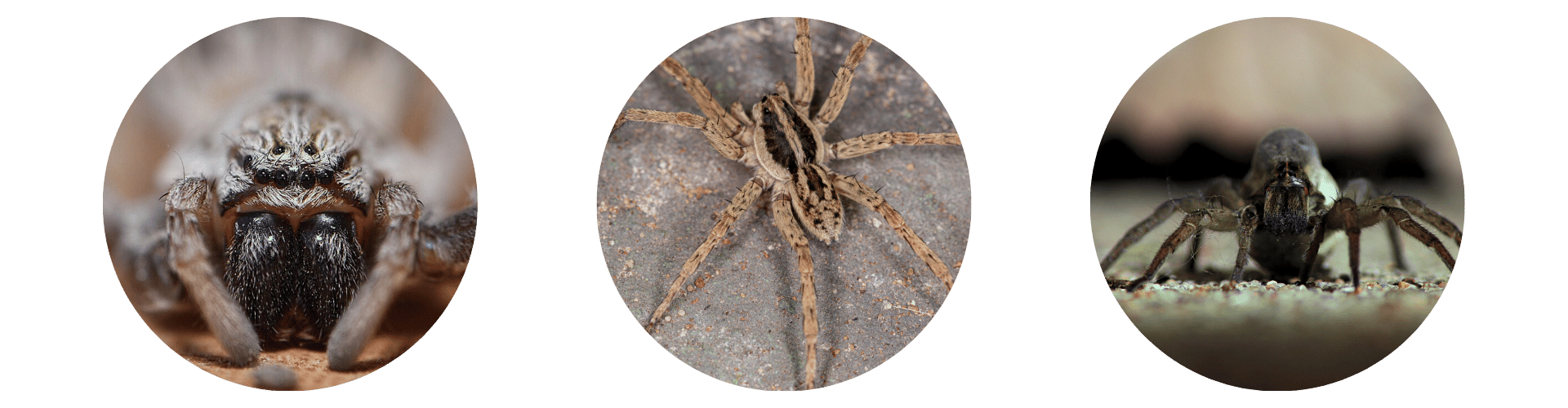
They’re bulky-bodied and athletic, as if they’ve spent time doing leg presses at the local gym. They come in a variety of colors, including brown, gray, and tan; some may have unique patterns, such as stripes or camouflage. Their legs are especially thick, hairy, and prominent, as they’re evolutionarily built for speed.
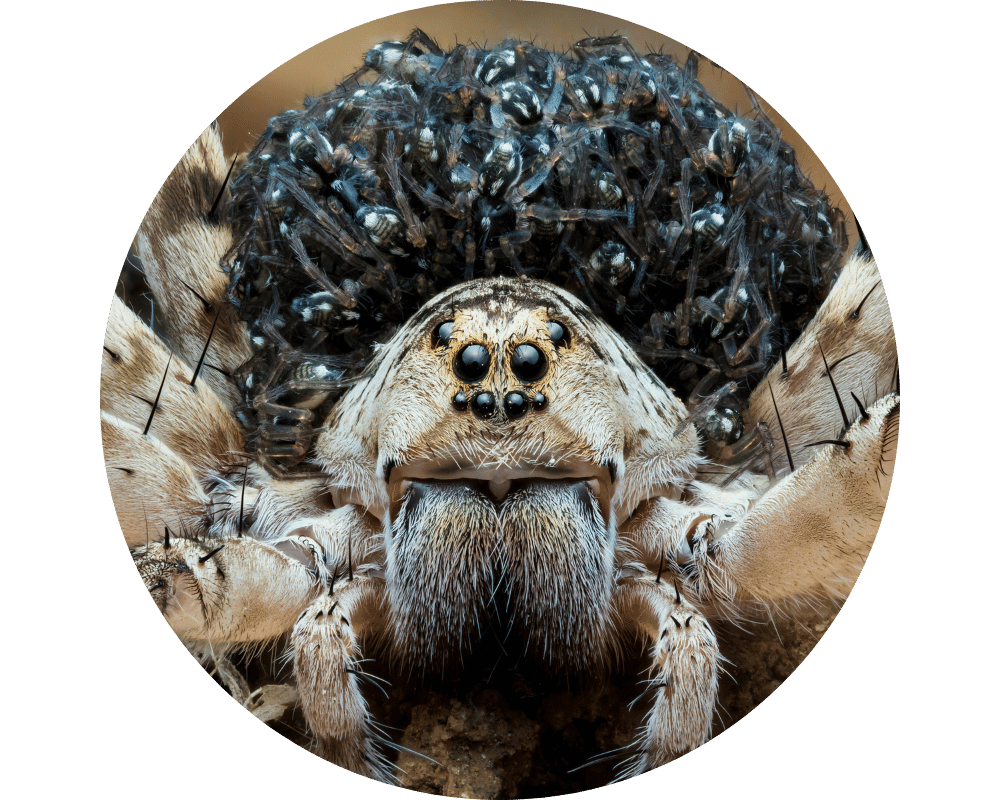
Perhaps wolf spiders’ most distinctive feature is their eyes (the foundation of their stellar vision). They have eight eyes in three rows, two on the top, two in the middle, and four on the bottom. Their eyes range in color from dark brown to black, although they reflect blue and greenish hues. Like cats, they shine prominently in the middle of the night, so you’ll know exactly when they’re staring at you.
Why Wolf Spiders Enter the Home
In New Jersey, wolf spiders are commonly found in homes and businesses, but they enter by accident rather than with the intention of settling down. Unlike other spider species, including cellar spiders, certain jumping spiders, cobweb spiders, and sac spiders, wolf spiders don’t live year-round indoors, preferring wooded areas, lawns and gardens, and sandy soil as their natural habitats.
One of the things that attracts wolf spiders is other pests. Because they feast on a spread of insects, any pest presence in your basement, garage, or kitchen can double as an all-you-can-eat arachnid buffet. Wolf spiders may also seek shelter during extreme temperature drops and overly dry conditions. They favor humid areas, such as soil and grass; if outdoor humidity drops, they may wander into laundry rooms, mudrooms, and bathrooms.
Like virtually all pests, wolf spiders are attracted to clutter, as it provides a place to hide, a stable climate, and cover from predators. Spiders especially thrive in dark, undisturbed places where they can seek their prey without interference from humans or other animals.
What To Do If You See a Wolf Spider?
Are wolf spiders dangerous? No, but they’re scary! If you see one, stay calm; these arachnids won’t pursue you . . . they’re more afraid of people than the other way around.
The first thing to do is avoid taking murderous matters into your own hands. In other words, don’t squish them; females can carry babies, which might spill out when pressed. If you’re able to relocate them (you brave soul, you), use the cup-and-paper method (just make sure the cup is big), and put them outside, in your garden, in your yard, or, even more ideally, across state lines.
If the size of a wolf spider deters you from getting too close, consider professional pest control. You should also consider seeking help if you see more than one spider or frequent visitors; wolf spiders are lone wolves, and seeing more than one indicates an underlying pest issue that Kapture can help address.
Our Website Is Loaded with Spidey Facts & Expert Tips
At Kapture, we treat wolf spiders, other arachnids, and a variety of pests common in New Jersey homes, businesses, and yards. Using eco-friendly, family- and pet-safe, and fast-acting solutions, we address issues at the root, remove pests, and use preventative maintenance to keep them from returning. Browse our “website” to learn more about our flexible, custom-made, and same-day services . . . and keep the webs (and their eight-legged residents) at bay.